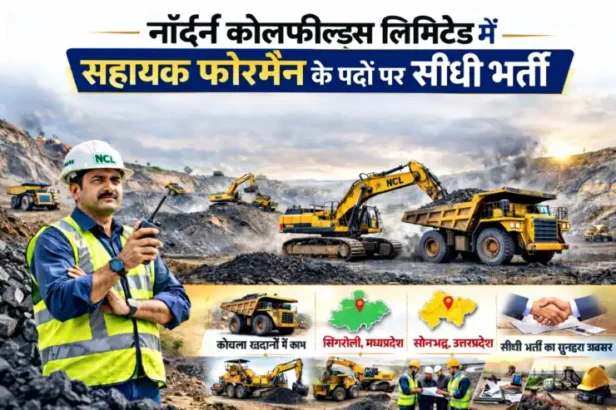
सहायक फोरमैन के पदों के लिए सीधी भर्ती द्वारा मध्यप्रदेश के सिंगरौली जिले एवं उत्तरप्रदेश के सोनभद्र जिले मे स्थित , खदानों एवं अन्य प्रतिष्ठानों मे नियुक्ति के लिए भर्ती
Table of Contents
1 पद ,न्यूनतम योग्यता एवं रिक्तियाँ :-
| स. क्र | पद का नाम | न्यूनतम / आवश्यक योग्यता | कुल पद |
|---|---|---|---|
| 01 | सहायक फोरमैन (ई एं ड टी) ग्रेड-सी( प्रशिक्षु ) | इलेक्ट्रॉनिक्स इंजीनियरिंग मे डिप्लोमा | 14 |
| 02 | सहायक फोरमैन (मैकेनिकल) ग्रेड-सी( प्रशिक्षु ) | मैकेनिकल इंजीनियरिंग मे डिप्लोमा | 108 |
| 03 | सहायक फोरमैन(इलेक्ट्रिकल) ग्रेड-सी ( प्रशिक्षु ) | इलेक्ट्रिकल इंजीनियरिंग मे डिप्लोमा | 148 |
2 महत्त्वपूर्ण तिथियां :-
| ऑनलाइन पंजीकरण और फॉर्म जमा करने की प्रारंभिक तिथि | 11/02/2026 (10:00 AM) |
| ऑनलाइन पंजीकरण और फॉर्म जमा करने की अंतिम तिथि | 05/03/2026 (11:59 PM) |
| एडिमट कार्ड डाउनलोड करने की अनुमानित तिथि | आधिकारिक वेबसाइट के माध्यम से सूचित किया जाएगा |
| कंप्यूटर आधारित परीक्षा की अनुमानित तिथि | आधिकारिक वेबसाइट के माध्यम से सूचित किया जाएगा |
| परिणाम की घोषणा की अनुमािनत तिथि | आधिकारिक वेबसाइट के माध्यम से सूचित किया जाएगा |
3 नॉर्दर्न कोल फ़ील्ड्स लिमिटेड मे सहायक फोरमैन पदों के लिए वेतनमान
प्रवेश स्तर ग्रेड व प्रशिक्षण के दौरान वेतनमान (NCWA XI के अनुसार) न्यूनतम (मासिक वेतन भोगी) ग्रेड -सी मूलवेतन रु 47330.25 प्रतिमाह ।
4 आरक्षण
अनुसूचित जाति / अनुसूचित जनजाति /अन्य पिछड़ा वर्ग– नॉन क्रीमी लेयर / आर्थिक रूप से कमज़ोर वर्ग/ पूर्व सैनिक/ विभागीय कर्मचारी / पीडब्लूबीडी श्रेणियों हेतु आरक्षण भारत सरकार के द्वारा प्रदत्त नियमों , दिशा -निर्देशों ,अधिसूचनाओं और इनमें समय-समय पर होने वाले संशोधनों के अनुरूप लागू होगा ।
5 आयु सीमा
अभ्यर्थियों की महत्वपूर्ण तिथियों (Crucial Date) पर आयु न्यूनतम 18 वर्ष एवं अधिकतम 30 वर्ष या कम होनी चाहिए ।आयु सीमा मे विभिन्न श्रेणियों के अभ्यर्थियों को अधिकतम 30 वर्ष की ऊपरी आयु सीमा मे रियायत है।
6 आवेदन शुल्क
अभ्यर्थियों को ऑनलाइन माध्यम से आवेदन शुल्क का भुगतान करना होगा ।
| अनारक्षित / अन्य पिछड़ा वर्ग– नॉन क्रीमी लेयर / आर्थिक रूप से कमज़ोर वर्ग | रु 1000 +लागू जीएसटी रु 180 = कुल रु 1180)( मात्र एक हजार एक सौ अस्सी रुपये) |
| अनुसूचित जाति / अनुसूचित जनजाति / पूर्व सैनिक/ विभागीय कर्मचारी / पीडब्लूबीडी | कोई शुल्क नहीं |
7 चयन प्रक्रिया
इस अधिसूचना के तहत निर्दिष्ट ऑनलाइन आवेदन जमा करने की अंतिम तिथि पर न्यूनतम पात्रता मानदंडों को पूरा करने वाले पात्र अभ्यर्थियों को कंप्यूटर आधारित परीक्षा में अभ्यर्थियों के तुलनात्मक प्रदर्शन के आधार पर चयन किया जायेगा ।
8 परीक्षा योजना
प्रत्येक पद के लिए अलग से कंप्यूटर आधारित परीक्षा आयोजित की जायगी | कंप्यूटर आधारित परीक्षा 90 मिनिट की होगी | परीक्षा 100 अंको की होगी , जिसमें दो खण्ड (खण्ड -ए और खण्ड -बी )शामिल होंगे |
9 परीक्षा आयोजन हेतु शहर
कंप्यूटर आधारित परीक्षा ऑनलाइन आवेदन में उल्लेखित परीक्षा शहरों में आयोजित
कि जाएगी । अभ्यर्थी अपनी प्राथिमकता के अनुसार सूची में से छह परीक्षा शहरों का विकल्प चुन सकते है और
ऑनलाइन आवेदन फॉर्म जमा करने के बाद इसे बदला नहीं जा सकता है। अभ्यर्थी को कोई भी परीक्षा शहर को आवंटित करने या अभ्यर्थी द्वारा चुने गए परीक्षा शहर को बदलने का एनसीएल अधिकार सुरक्षित रखता है।
10 आवेदन कैसे करें
अभ्यर्थी नॉर्दर्न कोल फ़ील्ड्स लिमिटेड की आधिकारिक वेबसाइट https://www.nclcil.in के माध्यम से ऑनलाइन आवेदन कर सकते है |
अधिक जानकारी एवं किसी भी अस्पष्टता / भ्रम की स्थिति में नॉर्दर्न कोल फ़ील्ड्स लिमिटेड की आधिकारिक वेबसाइट https://www.nclcil.in पर विजिट करे |
इसी तरह की भर्ती विज्ञापन के लिए विजिट करे www.dreamjobalert.in
पोस्ट से सम्बंधित विचार कमेंट सेक्शन में शेयर करें
पोस्ट का नोटिफिकेशन पाने के लिये वेबसाइट पर उपलब्ध न्यूज़ लेटर को फ्री में सब्सक्राइब करें
अनुलग्नक – ‘ए’ /ANNEXURE -‘A’
Section A (1-70 questions, MCQ of one mark each) -70 Marks
खण्ड ए (1-70 प्रश्न , 70 वस्तुनिष्ठ प्रश्न प्रत्येक 1 अकं का) – 70 अकं
Questions related to technical knowledge of discipline as per current curriculum of Indian
Universities/Institutes (Indicative syllabus has been given below) / भारतीय
विश्वविद्यालयों / संस्थानों के वर्तमान पाठ्यक्रम के अनुसार तकनीकी से सम्बंधित ) सांकेतिक
पाठ्यक्रम नीचे दिया गया है।
Detailed indicative syllabus for Section A (Technical section specific to different post) has
been given in subsequent pages.
Name of the Post: Assistant Foreman (E&T) T&S Gr – C (नॉर्दर्न कोल फ़ील्ड्स लिमिटेड)
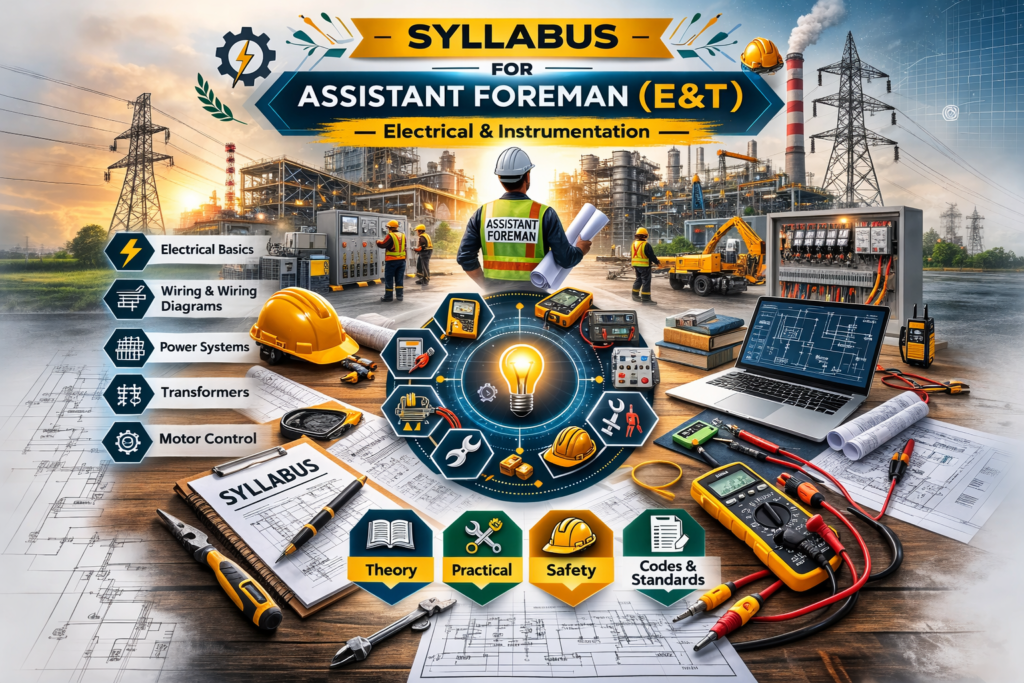
1. Networks Theory
Basic of Network Theory. Nodal and Mesh analysis. Network Theorems Superposition Theorem, Thevenin and Norton’s Theorem, maximum power transfer Theorem. Star-Delta transformation, Duality. Steady state sinusoidal analysis, Time domain analysis of simple linear circuits, Frequency domain analysis of RLC (Series and Parallel) circuits. Two port network parameters. Graph Theory.
2. Digital Electronics
Number systems, Code converters: BCD, Binary, IIEX, Octal other codes, Combinatorial Circuits. Boolean algebra. Karnaugh map. CMOS implementations. Arithmetic Circuits. Multiplexers. Encoder & Decoders. Sequential circuits- latches and all flip-flops, counters, shift-registers. Data converters- ADC (Analog to Digital Converter) and DAC (Digital to Analog Converter).
3. Semiconductor memories-
ROM (Read Only Memory), SRAM (Static Read Access Memory), DRAM (Dynamic read Access Memory)
4. Microprocessor (8085-8 Bit)-
Architecture, All Instruction, Programming, memory.
5. Signal and System Signal Operation–
Time Shifting, Scaling, & Reversal. System- Linear, causality, stability. Fourier series and Fourier transform representations, sampling theorem. Discrete-Time signals discrete-time Fourier transform, DFT (Discrete Fourier transform), FFT, and Z- transform. LTI systems- Properties, frequency response, group delay, phase delay.
6. Electronic Devices Circuits (EDC)
Energy bands in intrinsic and extrinsic silicon. Carrier transport- diffusion current, Drift current, Mobility and Resistivity, Diffusion constant, Generation and recombination of carriers. Diode, BJT (Bipolar Junction Transistor). P-N junction Transistor, Zener diode, MOSFET, LED (Light Emitting Diode), a photodiode and solar cell. Thyristor (SCR), Triac Diode, GTO, an IGBT, DC to DC conversion, Rectifier, Chopper.
7. Analog Electronics
BJT (Bipolar Junction Transistor), and MOSFETs, Simple diode circuits- clipping, clamping, and rectifiers. BJT and MOSFET amplifiers- multi-stage, differential, feedback, power and operational, Operational Amplifier circuits, Active filters. Oscillators- criterion for oscillation, RC Phase Shift, using transistor and FET, Wein bridge, Clapp’s, Colpitts oscillator only Formula. Function generators, wave-shaping circuits and 555 timers, Voltage reference circuits, Power supplies- ripple removal and regulation. Cathode Ray Oscilloscopes (CRT), Multimeters, and Digital voltmeters.
8. Control Systems
Basic control system, Transfer function meson’s formula, Block diagram representation, Signal flow graph. Transient and steady-state analysis of LTI systemsFirst and Second Order System. Frequency response- Routh-Hurwitz criterion, Polar Plot analysis, and Nyquist.
9. Analog Communication System
Amplitude modulation and demodulation For Sinusoidal, Rectangular and Triangular Signal, Angle modulation(Frequency and Phase Modulation) and demodulation, AM and FM Spectrum Analysis, super heterodyne receivers.
10.Digital communications
PCM (Pulse Code Modulation), DPCM (Delta Pulse Code Modulation), digital modulation schemes. Bandwidth Calculation, SNR (Signal to Noise ratio) and BER/Probability error for digital modulation, Fundamentals of error correction, Hamming codes, Inter-symbol interference. Basics of TDMA. FDMA, and CDMA (Code-division Multiple access). Information theory- Entropy, mutual information and channel capacity theorem.
11.Electromagnetics
Electrostatics, Maxwell’s equations, wave equation, Poynting theorem & vector. Plane waves- Reflection and refraction, polarization, phase and, group velocity, calculation of skin depth. Transmission lines- Equations, characteristic impedance, impedance matching. impedance transformation, S-parameters, Smith chart. Waveguides- Basic of Waveguides
12.Antennas-
Basic Concept, Definition, Types of Antenna, radiation pattern, gain, and directivity return loss etc.
13.Computer Networking
Network features-Network topologies, protocols- TCP/IP, UDP, FTP, models, types, network components, network medias, Specification and standards, types of cables, UTP, STP, Coaxial cables. Network components like hub, Ethernet switch, router, NIC Cards, connectors, media and firewall. Difference between PC & Server.
14.Voice Communication
Telephone instruments and signals: Introduction, the subscriber loop, standard telephone set, basic call procedure, cordless telephones, electronic telephones. Telephone circuit: Introduction, the local subscriber loop, channel noise and units of power measurements. transmission parameters, voice frequency circuit arrangements. Public telephone network: Transmission system, public telephone network, automated central office switches and exchanges, telephone switching hierarchy, common channel signaling system. Multiplexing of telephone channels: TDM, digital hierarchy, digital carrier line encoding, T-carrier systems, digital carrier frame synchronization, FDM, WDM. Digital telephony: Introduction, voice digitization, TDM of PCM signals, digital carrier, Fractional T-Carrier Service, Data Terminal, Digital Carrier Line Encoding, Error Detection, T Carrier System, T-1 Carrier System.
Name of the Post: Assistant Foreman (Mechanical) T&S Gr – C (नॉर्दर्न कोल फ़ील्ड्स लिमिटेड)
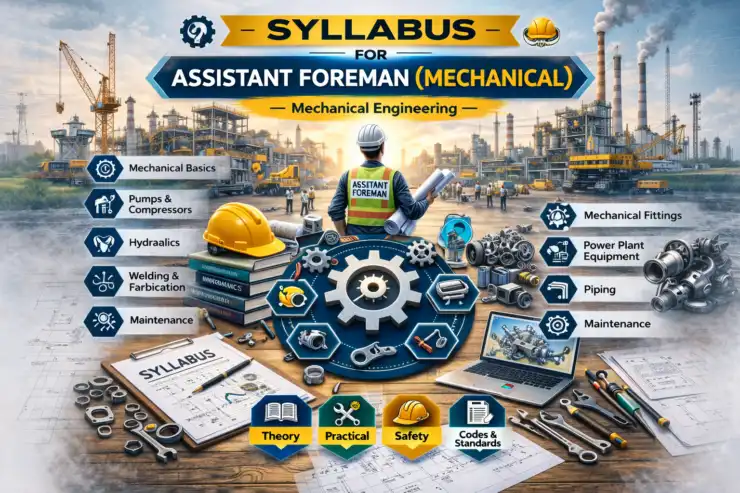
1. Theory of Machines and Machine Design Concept of simple machine, Four bar linkage and link motion, Flywheels and fluctuation of energy, Power transmission by belts Vbelts and Flat belts, Clutches – Plate and Conical clutch, Gears – Type of gears, gear profile and gear ratio calculation, Governors – Principles and classification, Riveted joint, Cams, Bearings, Friction in collars and pivots.
2. Engineering Mechanics and Strength of Materials: Equilibrium of Forces, Law of motion, Friction, Concepts of stress and strain, Elastic limit and elastic constants, Bending moments and shear force diagram, Stress in composite bars, Torsion of circular shafts, Bucking of columns – Euler’s and Rankin’s theories, Thin walled pressure vessels.
3. Thermal Engineering Properties of Pure Substances: p-v & P-T diagrams of pure substance like H2O, Introduction of steam table with respect to steam generation process; definition of saturation, wet & superheated status. Definition of dryness fraction of steam, degree of superheat of steam. H-s chart of steam (Mollier’s Chart). 1st Law of Thermodynamics: Definition of stored energy & internal energy, 1st Law of Thermodynamics of cyclic process, Non Flow Energy Equation, Flow Energy & Definition of Enthalpy, Conditions for Steady State Steady Flow; Steady State Steady Flow Energy Equation. 2nd Law of Thermodynamics: Definition of Sink, Source Reservoir of Heat, Heat Engine, Heat Pump & Refrigerator; Thermal Efficiency of Heat Engines & co-efficient of performance of Refrigerators, Kelvin Planck & Clausius Statements of 2nd Law of Thermodynamics, Absolute or Thermodynamic Scale of temperature, Clausius Integral, Entropy, Entropy change calculation of ideal gas processes. Carnot Cycle & Carnot Efficiency, PMM-2; definition & its impossibility.
4. Air standard Cycles for IC engines: Otto cycle; plot on P-V, T-S Planes; Thermal Efficiency. Diesel Cycle; Plot on P-V, T-S planes; Thermal efficiency. IC Engine Performance, IC Engine Combustion, IC Engine Cooling & Lubrication. Rankine cycle of steam: Simple Rankine cycle plot on P-V, T-S, h-s planes, Rankine cycle efficiency with & without pump work.
5. Boilers; Classification; Specification; Fittings & Accessories : Fire Tube & Water Tube Boilers. Air Compressors & their cycles; Refrigeration cycles; Principle of a Refrigeration Plant; Nozzles & Steam Turbines. 6. Fluid Mechanics & Machinery Properties & Classification of Fluid: ideal & real fluids, Newton’s law of viscosity, Newtonian and Non-Newtonian fluids, compressible and incompressible fluids. Fluid Statics Pressure at a point. Measurement of Fluid Pressure: Manometers, U-tube, Inclined tube. Fluid Kinematics: Stream line, laminar & turbulent flow, external & internal flow, continuity equation. Dynamics of ideal fluids:
Bernoulli’s equation, Total head; Velocity head; Pressure head; Application of
Bernoulli’s equitation. Measurement of Flow rate Basic Principles: Venturi meter, Pilot
tube, Orifice meter. Hydraulic Turbines Classifications, Principles. Centrifugal Pumps
Classifications, Principles, Performance.
7 Foundry & Casting methods, defects, different casting processes, Forging, Extrusion,
etc, Metal cutting principles, cutting tools, Basic Principles of machining with (i) Lathe
(ii) Milling (iii) Drilling (iv) Shaping (v) Grinding, Machines, tools & manufacturing
processes, etc. as per the courses offered by the Recognized Institutes.
Name of the Post: Assistant Foreman (Electrical) T&S Gr – C (नॉर्दर्न कोल फ़ील्ड्स लिमिटेड)
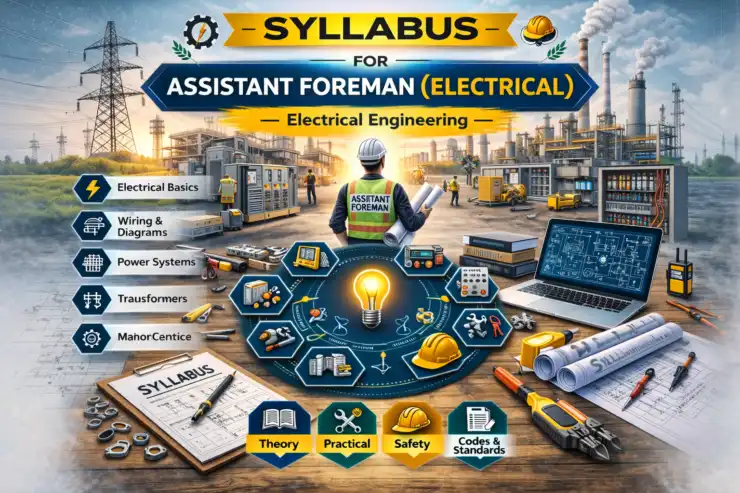
Electricity Theory (Elementary Knowledge)
Principles of Electricity – Electric voltage, Current and resistance, Ohm’s law – specific resistance, Laws of resistance and their application for calculating voltage drop, series and parallel circuits, Practical units of voltage, current, resistance, power and energy. Relation between electrical power unit (KW) and Mechanical Power Units (HP).
Electro Magnetism – Concept of Electro Magnetic Force (EMF), production of E.M.F., Flemings Right and Left Hand Rules, Magnetic, Chemical and heating effects of electric current. Magnetic properties of material, Electromagnets and their various applications.
Materials – Conductors, Semiconductors and insulator materials and their relative merits. Transformer oil, Effect of heat and moisture on insulation. Lubricants and their uses. Different types of wires, cables, switches, circuit breakers, cutouts, etc.
Generation of Electricity – Sources of natural energy. Renewable and Non-Renewable source methods of production of electricity both Alternating Current and Direct Current.
A.C. Generators (Alternators) – Essential components and constructional feature. Methods of voltage and frequency control conditions and methods for synchronizing, simple associated switchboard and its accessories.
D.C. Generators – Essential components and constructional features, Shunt, series and compound dynamos and their characteristics, causes for sparking. Commutators and their maintenance. Carbon brushes, their adjustment and care. Methods of voltage regulation. Conditions for parallel operation, simple associated switch board and its accessories.
Batteries – Primary cells, Dry cells, Lead acid cells, Nickel, Iron or Alkaline cells. Initial and subsequent charging of batteries. Charging circuits and their calculations. Series and parallel circuits. Maintenance of batteries. Use of Hydrometers.
A.C. Motors – Theory of induction (squirrel cage and slip-ring type) synchronous and commutator motors, their uses, installation, method of starting, speed control and reversal of direction.
D.C. Motors – Theory of series, shut and compound wound type motors, their uses, installation, method of starting, speed control and reversal of direction.
A.C. Circuits – Knowledge of vectors. Phase and phase difference. Resistance, inductance and capacitance in an A.C Circuit. Periodicity or Frequency. Power and power factor. Single phase and three phase systems, star and delta connections, Phase Sequence.
Controlling and Regulating Gear – Knowledge of various types of switches, circuit breakers, cutouts, starters, regulators and protective devices for both A.C. and D.C. motors and their wiring with the motors.
Transformation – Knowledge of single phase and three phase transformers, their construction, use and maintenance. Phasing out, parallel working, auto transformer, transformer tappings, temperature rise, instrument transformer.
Transmission and Distribution
Overhead Lines – Simple calculations and general principles of construction of low, medium and high voltage lines. Size of conductors, length of spans, sag, strength of poles, spacing of conductor, cross arms, effect of temperature. wind pressure, ice and snow, tension on wire. Insulators, brackets, stays, struts, guard wires and other protective devices. Earthing, lighting arrestors, lighting conductors and their testing and fault location.
Underground Cables – underground cables, simple calculations and general principles of laying cables direct in ground, in troughs and pipes. Handling, bending, jointing, plumbing. Underground and above ground junction boxes. Distribution board, Joint box compound, melting of compound and filling boxes with compound. Testing and fault location.
Illumination – Metal filament lamps, fluorescent lamp circuits, Photometric units and simple measurements. General requirements of efficient lighting and elementary calculations. Street lighting. Time switches.
Generation:-
a) DC and AC power supply for auxiliaries, arrangement of unit auxiliary and station service boards, station lighting and automatic changeover. Station batteries and charging methods. Stand by and emergency power and lighting systems.
b) Testing & Measurement – Working principle and basis of instrument and measurements. Details of measuring instruments for pressure, flow, temperature, level, alignment and current, voltage, power, reactive power, frequency, energy, winding temperature, auto controllers, recorder, insulation, tester, its use for primary detection of faults, data acquisition system, digital distributed control, UPS etc. Testing of electrical and mechanical equipments.
c) Control & Protection – Sequential operation & interlocks, general machine start/stop, sequence of operation.
Electricity Utilization for Domestic installation –
WIRING – Wiring layout of different types for lighting and power installations in residential premises together with the necessary switchgear, estimate of materials and cost of different types of installations. Wiring of temporary installations and portable appliances.
CIRCUIT DIAGRAM – Electrical connections of various circuits for (i) House wiring including those for main and sub-distribution boards, switches and cutouts etc.
APPARATUS – Installations and maintenance of heaters, cookers, refrigerators and other domestic appliances. Electric bells and indicators. Small motors for pumps and electric lifts.
ENERGY MEASUREMENT AND CHARGES – Energy meters both D.C. and A.C. for house service.
SIMPLE CALCULATION – Simple calculations relating to cost of energy, elementary knowledge of methods of charging for energy.
TESTING AND FAULT ATTENDANCE – Detection and location of faults in domestic appliances and wiring installations. Insulation and continuity test. Rectification of faults. Tests for insulation resistance to earth. Earth testing.
PROTECTIVE DEVICES – Elementary knowledge of the use of fuses and cutouts, earthing of domestic appliances, motors etc. use of lighting arrestors.
Industrial installation –
WIRING – Wiring layouts of different types for lighting and power installations in industrial premises together. with the necessary switchgear. Estimates of materials and cost of different type of installations. Wiring of temporary installations and portable appliances.
CIRCUIT DIAGRAMS – Electrical connections for D.C. & A.C. Motors, their starters regulators. Main and sub- distributing boards with circuit breakers, switches, fuse units with load statement for each circuit, D.C. & A.C. Motors, their starters regulators, Battery charging equipments, Converting machinery, Lifts with their safety devices.
PUMP INSTALLATIONS – General principles and elementary calculations of head, power and energy requirements.
APPARATUS – Installation and maintenance of generators, electric motors electric welding machines, haulage and winding machines, cooling and heating appliances.
POWER AND ENERGY MEASUREMENT AND CHARGES – Measurement of power, Watt meters, energy meters both D.C. & A.C. power factor correction by capacitors.
SIMPLE CALCULATION – Simple calculations relating to cost of power and energy, elementary knowledge of methods of charging for demand and energy.
TESTING AND FAULT ATTENDANCE – Detection and location of faults in D.C. & A.C. generators, motors, overhead distribution lines and underground cables, electric instruments and apparatus and wiring installations. Rectification of faults, Insulations and continuity tests. Tests for insulations resistance to each earth testing.
PROTECTIVE DEVICES – Elementary knowledge of earthing of generators, motors, machines, installations and appliances. Use of lighting arrestors, fuses including high rupturing capacity fuses, cutouts, circuit breakers, over load and no volt protections, thermal trips, filed breaking switches and over speed protection.
Overhead Lines
Survey, Design, Construction Standards, Foundation Erection, Stringing and Construction equipments.
Testing, fault locations, commissioning, maintenance and protections including safety devices and testing equipments.
Selection of supports, cross arms, brackets, stays struts insulators and associated hardwares.
Types and size of conductors, length of spans, sag, spacing of conductors, effect of temperature, wind pressure, ice and snow on tension of conductors, lighting on conductor.
Earthings, lighting arresters, guard wires, relays and other proactive devices.
Cables
Classification of cables, criteria for the selection of power cables, PVC & XLPE underground cables. Classification of tests for cables laying, safe handling of cable drums, cable joints, cable terminations, crimp connections, maintenance of electric cable, flexible cable, flexible cables for portable machines, faults in underground cables system, methods of fault location underground cable system.
Sub-Stations and Control Room:
Layout, design, construction standards of HT transformers and associated equipments (i.e. CBs, Isolators, Las, Capacitors, CTs, PTs, etc)
Power and distribution transformers – their erection, commissioning, fault locations, and maintenance.
Protective relays and measuring equipments and their networking.
Transformer protection, Generator, Diesel Generator protection.
Testing commissioning, fault locations, maintenance and protection of cables and testing equipments.
Design and installation of capacitor banks and their maintenance.
Erection, testing, commissioning and maintenance of control room equipments including station batteries and communication system. .
Motors and Generators (DC and AC):
Installation, testing, commissioning, protection and control and maintenance of industrial motors.
Operational knowledge for the following:- Operational knowledge on measuring instruments i.e Ammeters, Voltmeters, Multimeters, Tongue Testers, Meggers, HV testing kits etc. Illumination, fire fighting and earthing systems including maintenance. Preparation, representation, interpretation of electrical drawings and execution of electrical work. Flame proof equipment/ intrinsically safe for underground switch board, panels, breakers etc for underground.
SAFETY RULES- Working Knowledge of- Safety regulation -2010 of CEA (Measures relating to safety and electric supply) All regulations including Regulations for mining installation. Fire safety procedures, fire protection of generators, transformer and fire fighting and protection . Protection and restoration of persons suffering from electric shock.
प्रश्न 1 क्या कोई अनुभव की आवश्यकता है ?
अनुभव की आवश्यकता नहीं है
प्रश्न 2 क्या नेगेटिव मार्किंग है
नेगेटिव मार्किंग नहीं है
Leave a Reply